
Now Offering Flexible Financing! Click Get Started Today
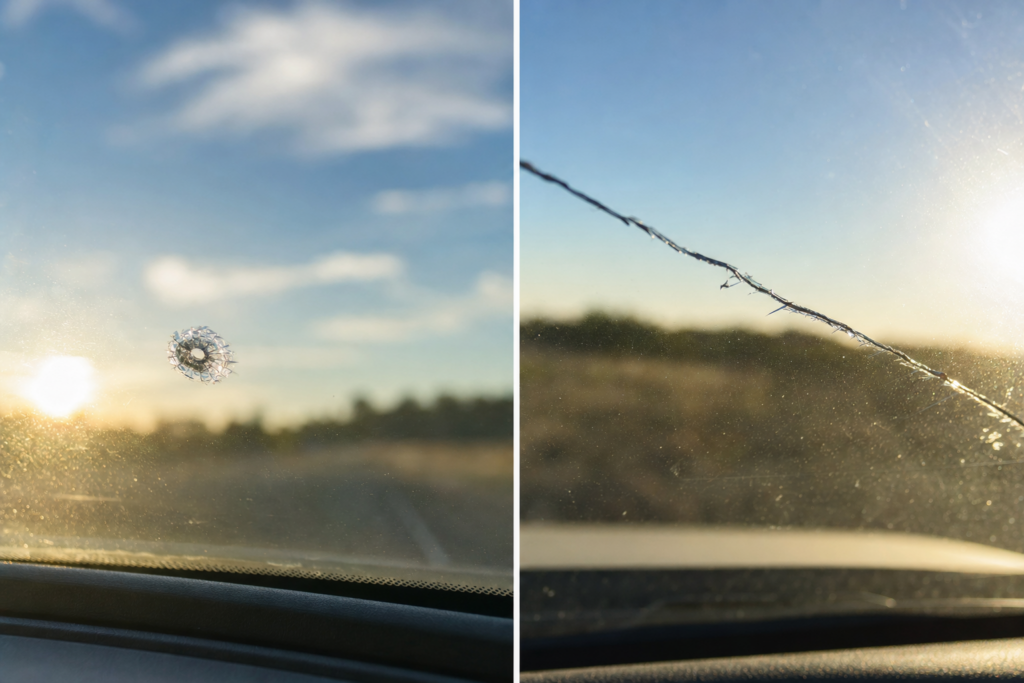
When you notice a rock chip or crack in your windshield, the first question is always the same: can this be repaired, or does the entire windshield need to go? The answer depends on several specific factors, and making the wrong call costs you time, money, or safety. Here’s how Texas drivers should think through the decision.
Most rock chips qualify for repair if you catch them quickly. The repair process works by injecting a clear resin into the damaged area, which bonds to the glass and restores structural integrity. When done correctly, a repaired chip is significantly less visible and the windshield is safe to use.
The conditions that allow for repair are specific. The chip must be smaller than a quarter in diameter. It must not penetrate all three layers of the windshield glass assembly. It must be located outside the driver’s primary line of sight, typically defined as a 12-inch area centered in front of the steering wheel. And it must be structurally clean, meaning no contamination, moisture, or debris has been worked into the break.
If a chip meets all of those conditions and you get to it within a few days of impact, repair is almost always the right call. It’s faster, significantly less expensive than replacement, and covered at no cost by most Texas auto insurance policies.
Replacement becomes necessary when damage crosses specific thresholds. The most common triggers are size, location, and type of damage.
A crack longer than six inches cannot be repaired. The resin injection process cannot restore structural integrity across a crack of that length, and any attempt degrades the surrounding glass. A chip larger than a quarter is similarly beyond repair capability.
Location matters as much as size. Damage in the driver’s direct line of sight presents a safety problem even after repair because the resin process, while effective structurally, may leave minor optical distortion. Industry standards and most state inspection guidelines require replacement for damage in this zone.
Edge cracks, damage that reaches the outer edge of the windshield, always require replacement. The edges of a windshield are structural. Edge cracks compromise the seal and the windshield’s ability to support the roof in a rollover. This is not a borderline call.
Finally, any damage to the inner layer of the glass laminate requires replacement. The outer layer is designed to absorb impact and chip. If a rock has penetrated deep enough to reach the inner layer, the structural bond of the glass assembly has been compromised in a way that repair cannot address.
Rock chips don’t stay small. Texas roads are hard on windshields: temperature swings between hot days and air-conditioned interiors, vibration over rough surfaces, and even the physical pressure of closing a car door can cause a small chip to crack outward within days or weeks of impact.
What would have been a $0 insurance repair becomes a full replacement. More importantly, a cracked windshield is a weakened windshield. In an accident, a structurally compromised windshield may not perform as designed. Modern windshields are engineered as part of the vehicle’s safety system, providing a significant portion of roof crush resistance in rollover scenarios.
The practical message is simple: if you see a chip, get it evaluated the same day or within 24 hours. The window for repair closes quickly.
Advanced driver assistance systems have changed windshield service in ways that many drivers haven’t considered. If your vehicle has a front-facing camera mounted to the windshield, which is standard on most vehicles built after 2018, that camera system must be recalibrated after any windshield replacement.
ADAS calibration ensures that your lane departure warning, automatic emergency braking, adaptive cruise control, and related systems are operating accurately. A camera that’s off by even a small margin can generate false alerts, fail to detect hazards at the correct distance, or simply not work as designed.
This matters for the repair-vs-replace decision in two ways. First, it adds cost to replacement that you need to factor into your evaluation. Second, it means that choosing a shop with in-house ADAS calibration capability is important when replacement is necessary. Avoid shops that skip calibration or refer you elsewhere for it.
Most rock chip repairs don’t affect ADAS cameras because the repair doesn’t require removing the glass. But if the chip is in or near the camera’s field of view, a qualified technician should check camera performance after the repair.
In Texas, most auto insurance policies cover windshield repair at no cost to the policyholder, and many policies also cover replacement with only a deductible payment. If you carry comprehensive coverage, contact your insurance provider before paying out of pocket for either service.
Cash pricing for rock chip repair typically runs $75 to $150 for a single chip. Windshield replacement on a standard passenger vehicle runs $250 to $500 for the glass itself, plus ADAS calibration if your vehicle requires it. Calibration typically adds $150 to $300 to the total cost.
When insurance covers the repair, the calculus is straightforward. When you’re paying out of pocket, a chip that clearly qualifies for repair should be repaired rather than waiting for it to become a replacement situation.
Texas roads generate more windshield damage than most states. The combination of heavy commercial truck traffic on highways, chip-prone road surfaces in construction zones, and extreme temperature variation between seasons means that windshield damage is common and its progression is fast.
In Houston-area summer heat, a small chip can crack across a windshield overnight as thermal expansion puts stress on the existing damage. In winter, even minor temperature drops can do the same. Texas drivers don’t have the luxury of waiting a week to decide what to do about a chip.
If you’re in the Houston area, The Woodlands, or surrounding communities, get damage assessed quickly by a qualified technician who can tell you definitively whether repair or replacement is appropriate for your specific situation.
Texan Glass provides rock chip repair, windshield replacement, and ADAS camera calibration at locations throughout the Greater Houston and North Texas area. Our technicians can evaluate your damage and give you a clear answer on whether repair is an option for your windshield.
Don’t let a small chip become a full replacement. Find your nearest Texan Glass windshield replacement location and schedule an evaluation today.